
When we started our EDI journey, the ‘e’ in EDI stood for equality. However, as we have progressed in this work, we have come to appreciate that what we are striving for is actually ‘equity’. You might think that both these words mean broadly the same thing, but actually there are some quite distinct differences.
While both concepts aim to promote fairness and justice, they approach this goal in fundamentally different ways.
Equality is about treating everyone the same. It’s based on the principle that everyone should have access to the same opportunities and resources. While this sounds fair in theory, it doesn’t account for the varied starting points and unique challenges that our members face. Equality assumes a level playing field. In reality, not everyone begins from the same place. The saying that we are all in the same storm but not the same boat illustrates this well.
Equity, on the other hand, is about recognising and addressing these differences. It involves providing individuals with the specific resources and opportunities they need to succeed, tailored to their unique circumstances. By focusing on equity, we ensure that support is distributed based on need, which helps to level the playing field in a more meaningful way.

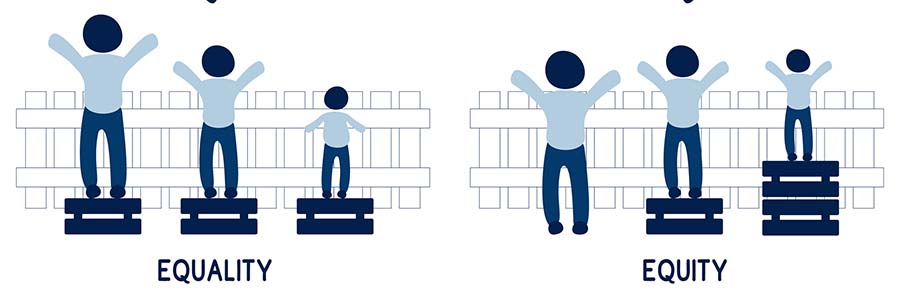
The image above illustrates the distinction between equality and equity in a compelling manner. On the left, equality is depicted by giving three individuals of different heights the same number of boxes to stand on, resulting in only the tallest person being able to see over the fence.
Conversely, the right side demonstrates equity, where each individual receives a different number of boxes according to their specific needs, enabling all to view equally. This visual underscores that while equality treats everyone identically, equity acknowledges individual differences and allocates resources accordingly, ensuring fair access and opportunities for all.
Why equity matters
- Promoting inclusivity: Equity fosters an inclusive environment where all voices are heard and valued. By addressing the specific barriers that some members face, we can create a more welcoming and supportive community for everyone.
- Driving true change: While equality is a noble goal, it often falls short in practice. Equity, however, drives true change by tackling the root causes of disparity. This approach allows us to create lasting improvements to benefit our members.
- Enhancing membership experience: A commitment to equity strengthens our organisation and enriches the membership experience. It helps us attract and retain a diverse membership and builds stronger relationships among members.
In practice, our commitment to equity means that we are actively seeking to remove barriers to ensure diverse representation and participation at all levels of our organisation.
By focusing on equity, we are dedicated to creating an environment where all members can participate. This approach not only benefits individuals but also strengthens our entire community.
As with all aspects of Equity, Diversity and Inclusion (EDI), it is members’ lived experience of EDI within STEP that matters. While we have made some progress, there is more work to be done. We will know we are making progress with embedding equity into STEP when our committees and governance structures better reflect the rich diversity of our membership. We would welcome feedback from members about our overall progress with embedding EDI into STEP’s work and your support, as members, in helping us achieve it.
Assad Abdullatiff TEP, Chair of STEP’s Equity, Diversity and Inclusion Committee
 The STEP Blog